

A small bathroom doesn’t automatically rule out an automatic opening and closing toilet seat. It can be a practical fit when the lid has room to move and the sensor won’t be triggered by nearby foot traffic. The key is matching the opening mechanism and toilet setup to the space.
It’s reasonable to ask whether automatic features add convenience or make a small bathroom harder to use. This guide explains how sensors and controls work, what toilet fit and installation involve, and which features affect your choice, so you can weigh the trade-offs before buying.
You’ll also see how an automatic-lid bidet seat differs from an integrated smart toilet, what to consider when adjusting lid movement, and how to assess clearance in a compact layout. The goal is a confident choice that fits your bathroom and the way you use it.
Key Takeaways
- Compare sensor placement and lid movement to see whether an automatic seat will work smoothly in a compact bathroom.
- Learn which installation details affect everyday use, from toilet clearance to soft-closing adjustments.
- Understand how manual controls can help you manage automatic opening when you prefer more control.
- Compare a replacement bidet seat with an integrated smart toilet to narrow down the right fit for your existing bathroom.
- See how features and product type shape prices, so you can compare options by value rather than by automation alone.
Automatic lid sensors and trigger methods
Yes. Look for a sensor that responds to your approach, enough clearance for the lid to open, and a way to manage automatic movement. An automatic opening and closing toilet seat should fit your bathroom layout and give you the level of control you want.
Automatic Lid Sensors
Automatic lid sensors detect someone approaching and can raise the lid without a hand-operated control. As the person walks away, the lid can close. Sensor response and placement affect how the seat behaves, so consider where people enter, stand, and pass the toilet. In a narrow bathroom, a sensor facing the doorway may respond before someone intends to use the toilet.
Lid Trigger Methods
Approach and departure are the main automatic triggers: someone arrives, the lid opens, and walking away prompts it to close. Manual operation works differently, requiring the user to operate a control instead of relying on motion detection. Consider whether hands-free movement suits your routine or whether you’d rather decide when the lid moves.
Before comparing models, consider the sensor’s likely line of sight. Note whether it faces a doorway, shower entrance, or nearby walking route. Also check the lid’s full movement path: a sensor may open it automatically, but the lid still needs clearance above and behind the bowl. These details matter especially in compact bathrooms.
| Option | Trigger | Best fit | Point to compare |
|---|---|---|---|
| Approach sensor | Person approaches | Hands-free opening | Sensor direction and placement |
| Departure response | Person walks away | Automatic closing | Whether the lid closes as expected |
| Manual control | User operates a control | Direct user choice | Ease of reaching and using it |
Sensor automation controls the lid, not the toilet’s water use. WaterSense-labeled toilets in the United States use at least 20% less water than the federal standard while meeting WaterSense performance requirements, according to the U.S. Environmental Protection Agency. Treat water efficiency as a separate comparison from automatic opening, since one feature does not establish the other.
Choose by matching the trigger to your layout and habits. If a walkway crosses the sensor’s view, prioritize controllable operation; if hands-free opening matters most, assess the sensor’s position and the lid’s path. A bidet toilet seat selection is a useful comparison point for distinguishing seat-based features from an integrated toilet’s functions.
Installation and adjustments
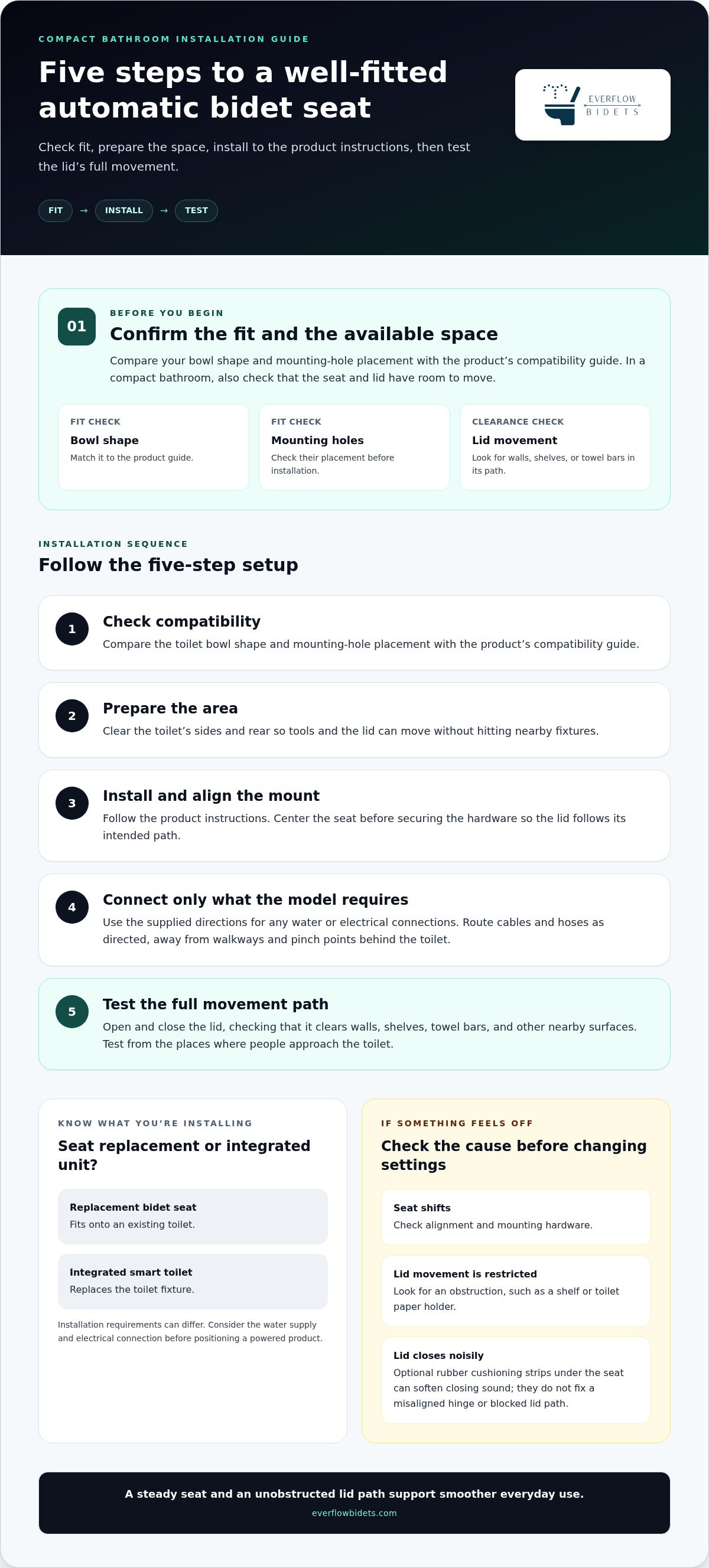
Installation affects more than whether a seat stays securely in place. Hinge position, mounting hardware, water connections, and power access can all affect everyday use. Before starting, compare your toilet’s shape with the seat’s fitting guide. A crooked or shifting seat can make positioning uncomfortable and interfere with smooth lid movement.
Start with the manufacturer’s instructions, since mounting plates and fasteners vary by model. Check the bowl and seat area for damage, then identify how the existing seat attaches. After removing it, clean the mounting surface and align the new hardware with the toilet’s holes. Center the seat before tightening the fasteners so the lid follows its intended path.
- Check the fit: Compare the toilet bowl shape and mounting-hole placement with the product’s compatibility guide.
- Prepare the area: Clear the toilet’s sides and rear so tools and the lid can move without hitting nearby fixtures.
- Install the mount: Follow the product instructions and keep the seat aligned before securing its hardware.
- Connect required utilities: Use the supplied directions for any water or electrical connections the model requires.
- Test the movement: Open and close the lid, then check that it clears walls, shelves, and towel bars.
Powered bidet seats and integrated smart toilets can have different installation requirements. A replacement seat fits onto an existing toilet, while an integrated unit replaces the fixture. For a powered product, consider the electrical connection and water supply before positioning it. Route cables and hoses as the manufacturer directs, keeping them out of walkways and clear of places where they could be pinched behind the toilet.
After installation, adjust the seat and test its movement from the places where people approach the toilet. A nearby cabinet, for example, may obstruct the lid even when the seat is centered. If the lid closes noisily, optional rubber cushioning strips under the seat can soften the sound. They address closing noise, not a misaligned hinge or blocked lid path.
Make one adjustment at a time. If the seat shifts, check its alignment and mounting hardware before changing other settings. If the lid’s movement is restricted, look for an obstruction such as a wall-mounted shelf or toilet paper holder. Finish by checking that the seat is steady and the lid moves fully without hitting nearby surfaces.
For a bathroom update that includes a replacement seat, compare bidet toilet seat options alongside your toilet’s fit and installation requirements.
Manual controls and disabling automatic opening
Manual controls are useful when a sensor opens the lid at the wrong moment. They also give household members a direct way to operate the seat. Compare the available controls before choosing: a remote, a button on the unit, or a setting that switches automatic movement off can make everyday use more predictable.
First, identify what each control does. A control may open the lid, close it, or switch off automatic operation. These functions aren’t interchangeable. Disabling automatic opening, for example, may leave automatic closing active, while another setting may stop both. Read the labels and product instructions to understand each function before changing settings.
Manual operation alongside sensors
A manual control offers an alternative to approach-based activation. It can suit a bathroom where movement near the doorway triggers the lid unexpectedly, or where users prefer different routines. Compare the controls’ location and labels: a button on the seat and a handheld remote differ in reach and storage needs.
When testing controls, use a simple sequence:
- Locate the manual open and close controls using the product’s labels or instructions.
- Operate the lid manually and observe whether it completes the movement smoothly.
- Test the automatic setting separately, noting which actions remain enabled.
- Restore the setting you prefer, then show other household members how to use it.
This sequence helps distinguish a control issue from a sensor response. If a button moves the lid but approaching doesn’t, for instance, the manual function works while automatic activation behaves differently. Note which setting produced each result. That makes it easier to restore your preferred setup after cleaning or a power interruption.
Disabling automatic opening can help in a narrow bathroom, a shared space, or a home where people pass close to the toilet. It can also prevent unintended movement during cleaning. Check whether the setting affects opening only or automatic closing too. That difference changes how the lid behaves after someone leaves.
Choose controls based on reach, clarity, and household routine. A clearly labeled remote may suit someone who prefers operating the seat without bending, while a seat-mounted button may be easier to find if the remote is stored elsewhere. In a shared bathroom, prioritize simple controls that make the preferred mode clear to everyone.
As you compare seat controls, review bidet toilet seat options alongside the operating features that matter in your bathroom. A useful comparison focuses on whether manual actions and automatic settings can work independently, rather than assuming every control changes the same function.
Toilet compatibility and installation
First decide whether you’re replacing a seat or changing the entire fixture. An integrated smart bidet toilet has electronic functions built in, while a bidet toilet seat replaces the seat on a compatible existing toilet. The first option involves a broader bathroom change; the second depends on a suitable bowl and mounting arrangement.
For a replacement seat, compare the toilet’s shape, bowl dimensions, hinge position, and mounting area with the product’s fitting guide. A mismatch can leave the seat poorly aligned or stop its lid moving freely. Check whether your toilet has a round or elongated bowl, then compare it with the seat’s specified fit.
Use this inspection sequence before choosing a model:
- Identify the toilet type: Record the manufacturer and model name if visible on the fixture or its documentation.
- Check the bowl: Compare its shape and dimensions with the seat’s fitting diagram.
- Inspect the mounting area: Look for the hinge holes, available space, and any obstructions behind the toilet.
- Review utility needs: Note whether the chosen model requires a water connection, electrical supply, or both.
- Assess lid clearance: Consider nearby walls, shelves, and cabinets along the lid’s opening path.
Installation depends on the product type. A replacement seat attaches to an existing toilet, while an integrated unit replaces the fixture. Powered features can also affect setup: review the model’s instructions for water and electrical connections, then route them without pinching a hose or trapping a cable behind the bowl. A non-electric bidet attachment does not provide heated water, a dryer, or a motorized lid.
Automatic flushing raises a separate compatibility question. Before buying a toilet with an automatic lid, confirm its approved backup-flush method and whether it requires a separate battery pack, battery box, or accessory. This matters if the usual power source is unavailable, because the backup method and required equipment vary by model.
In a small bathroom, assess the layout before installation. Open the existing lid fully and note its path, then compare it with the proposed unit’s clearance requirements. A nearby vanity or shelf may restrict movement even when the toilet fits. Also consider whether the sensor and controls will remain accessible after installation.
Choose a replacement seat if your existing toilet meets the seat’s requirements and you want to keep the fixture. Consider an integrated smart toilet for a broader fixture change with electronic functions built in. For either option, use the model’s fitting instructions to make the final compatibility decision.
Automatic toilet seat product prices
What are the best automatic-opening toilet seats in the United States? The right choice fits your toilet, offers lid controls you’ll use, and suits your bathroom layout. Compare these essentials before prioritizing extra features.
Are automatic toilet seats safe and hygienic to use? They’re designed for routine bathroom use, but safe operation depends on correct installation and following the product’s cleaning instructions. Automatic lid movement is a convenience feature, not a substitute for regular cleaning.
What are the pros and cons of automatic toilet seats? Hands-free lid movement reduces the need to lift or lower the seat manually, but sensors may respond when no one intends to use the toilet. Manual controls and adjustable automatic operation can help manage that trade-off.
Prices vary by product type and included functions. A replacement bidet seat and an integrated smart toilet are different purchases: one fits an existing toilet, while the other replaces the fixture. Compare products within the same category first, so the cost of a larger installation doesn’t obscure the value of a particular seat feature.
Use this checklist to assess value rather than judging by the automatic lid alone:
- Product type: Decide whether you need a replacement seat or a complete toilet.
- Lid operation: Compare automatic opening, closing, and manual controls.
- Fit: Match the product to the toilet’s shape and mounting arrangement.
- Installation: Consider required water and electrical connections.
- Backup operation: For an automatic-lid toilet, account for its approved backup-flush method and any required battery accessory.
A lower-priced seat may provide the lid function you want, while a more complex product may combine that function with other electronic features. Ask whether those additions solve a real need. A household seeking hands-free lid movement, for example, may value it more than functions used rarely.
Compare the everyday experience as well as the initial cost. Consider how the lid responds to movement, whether everyone can understand the controls, and how easily the seat can be cleaned. In a compact bathroom, a feature has less value if the lid’s movement conflicts with a nearby wall or cabinet.
Before choosing, compare two or three options in the same product category. Note each model’s fit, control method, installation requirements, and backup needs. Then weigh the features you’ll use against those you can do without. This helps distinguish practical value from a longer feature list.
To compare seat styles and functions for your bathroom, explore bidet toilet seat options and assess each against your toilet’s fit and preferred controls.
The best choice is a seat that fits your toilet, offers lid controls you’ll use, and suits your bathroom layout. Compare options in the same product category by fit, operation, and installation requirements before weighing extra features.
EverFlow Bidets: Bidet Toilets
EverFlow Bidets sells bidet toilets, bidet toilet seats, and bidet toilet combinations for different bathroom plans. If your existing toilet fits a replacement seat, a bidet toilet seat lets you upgrade without replacing the fixture. For a broader bathroom change, a bidet toilet or combination may better suit your goals.
Use this guide to narrow your priorities: lid operation, toilet fit, installation needs, and preferred controls. Then compare options by product type and features rather than assuming every bidet seat includes an automatic lid. The right choice depends on your bathroom and the features that matter in your daily routine.
Visit everflowbidets.com to explore bidet options for your bathroom.
Make Your Bathroom Upgrade Work for You
A bathroom upgrade can shape daily routines for years, so consider how your needs may change. An automatic opening and closing toilet seat could be part of a broader effort to make everyday tasks more comfortable and manageable. Think beyond the purchase: what would make the room easier to use as your household’s routines evolve?
Before deciding, write down the improvement you want most from this upgrade. A clear priority gives you a useful standard for comparing options and keeps the decision focused on what matters at home. Choose what supports your comfort and confidence, not simply the product with the longest feature list.
For help exploring bathroom hygiene options, contact EverFlow Bidets. Move forward with a plan that feels right for your home and the way you want to use it.
Frequently Asked Questions
Is a smart toilet with an automatic lid suitable for a small bathroom?
Yes, if the complete fixture suits the room and leaves space for everyday tasks. Compare the smart toilet’s dimensions with your current unit, then consider access to toilet paper, cleaning supplies, and storage. Automatic lid operation alone doesn’t show how much room the toilet requires. A dimension drawing is more useful than judging from product photos.
What happens during a power outage?
Powered electronic functions may stop during an outage, and what remains usable depends on the model. Before an outage, find the manual’s instructions and learn the physical flush procedure separately from the lid controls. Keep that information accessible to everyone in the household. This preparation helps people respond confidently rather than experiment with unfamiliar controls during a disruption.
How do automatic opening and closing toilet seats work?
An automatic opening and closing toilet seat uses a sensor to detect someone approaching and can close the lid after they leave. The term describes lid movement only. It doesn’t mean the toilet also flushes automatically or includes bidet washing, a dryer, or other electronic functions. Compare those features separately: automatic lid movement doesn’t indicate what else a product can do.
How much do automatic toilet seats cost?
There isn’t one price for every model. Compare current product listings, making sure you’re looking at the same type of product, such as a replacement seat or an integrated toilet. Review what each listing includes and account for installation items sold separately. Prices can change, so use the current listing to set your budget rather than an older saved quote.
How do you install an automatic toilet seat?
Follow the exact model’s installation instructions, since mounting and connection steps vary. Before beginning, set aside the manual and organize the supplied hardware so small parts aren’t misplaced. Plan the installation for a time when the bathroom can be temporarily unavailable. Keep the instructions with household records for future cleaning, troubleshooting, or removal.
Are automatic toilet seats compatible with standard toilets?
No, compatibility isn’t universal. “Standard toilet” doesn’t describe every bowl shape or hinge layout. Compare your specific toilet with the seat manufacturer’s compatibility information. If the toilet has an unusual shape or concealed mounting area, pay close attention to the fitting diagrams. Reviewing the product’s fit guidance before buying can prevent choosing a seat that won’t attach properly.
Do automatic toilet seats require batteries or an electrical outlet?
Power requirements depend on the model and its functions. A battery accessory for backup flushing doesn’t necessarily power the lid or other electronic features. Read the product instructions to distinguish the seat’s normal operating power from any backup system. This helps you plan the bathroom’s electrical setup and understand which functions may remain available if the main power source fails.
How do you clean and maintain an automatic toilet seat?
Check the product instructions for its controls, and consider disabling automatic movement during cleaning to prevent unintended lid movement. After cleaning, restore your preferred setting and test the lid. Rubber cushioning strips under the seat can soften closing noise.
Disclaimer
The information provided in the EverFlowBidets blog is for general informational and educational purposes only. While we strive to publish accurate, current, and well-researched content, nothing on this website should be considered medical advice, diagnosis, or treatment. Articles discussing the potential health, hygiene, accessibility, or environmental benefits of bidet use are based on publicly available research, manufacturer information, and other reputable sources. Individual results may vary, and any health-related decisions should be made in consultation with a qualified healthcare professional.