

Toilet paper is a recurring household expense that can add up faster than it seems. The actual total depends on how quickly your family goes through rolls and what you pay for each pack.
It’s easy to focus on the price tag and overlook how long a pack lasts or how much paper each roll contains. This guide compares annual spending, pack longevity, and standard, mega, and jumbo roll sizes so you can judge value more accurately. You’ll also see how recurring costs add up over time and how a bidet can change the amount of toilet paper a household uses.
Key Takeaways
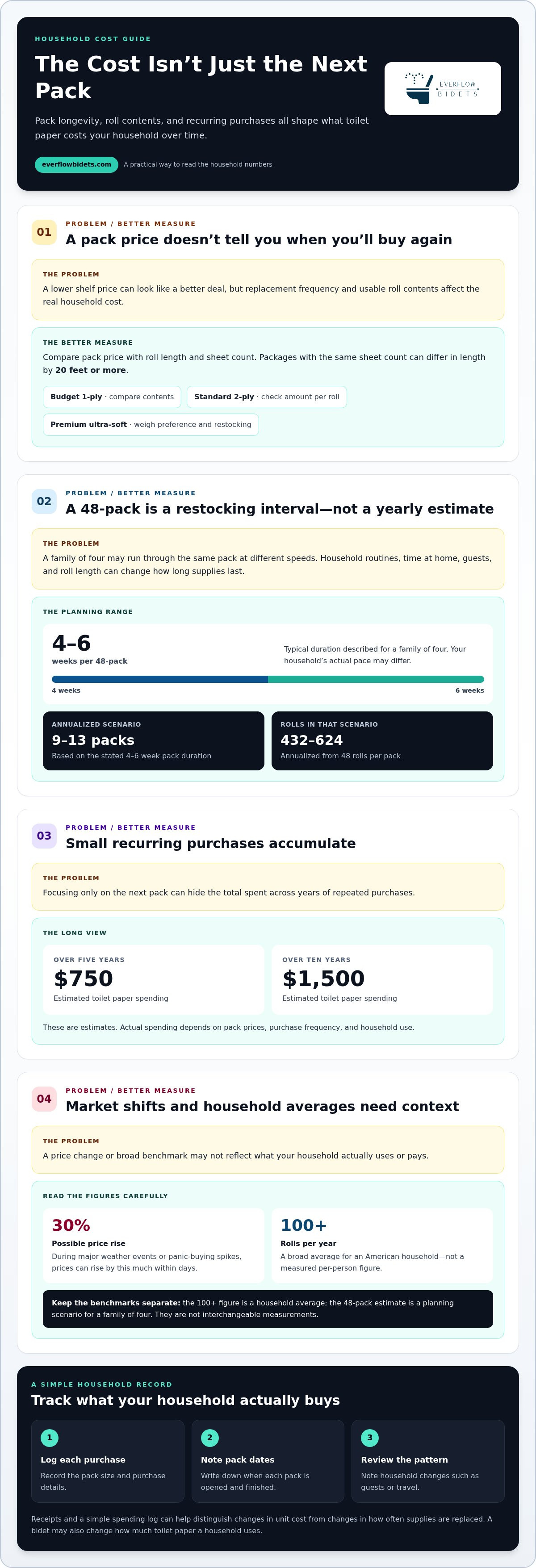
- A 48-pack typically lasts a family of four four to six weeks, making pack price and replacement frequency useful budget measures.
- Toilet paper spending can reach $750 over five years and $1,500 over ten, so recurring purchases deserve a place in long-term household planning.
- Compare rolls by length and sheet count, not just the number of rolls; packages with the same sheet count can differ in length by 20 feet or more.
- Consider how a bidet might reduce your household’s reliance on toilet paper when weighing ongoing bathroom expenses.
Annual household toilet paper spending
That estimate offers a practical starting point for your budget, not a fixed bill. Brand, ply, sheet count, household routines, and when you shop all affect the final total.
Those differences matter when a household buys toilet paper repeatedly throughout the year.
How much does a 12-pack of toilet paper cost in the US? Actual pack prices vary with brand, ply, and product size.
Household routines shape how quickly supplies run out. More residents at home, frequent guests, and personal habits can all increase purchases. Age may influence routines and preferences, but it does not determine consumption on its own. Track what your household actually buys to identify the factors driving its use.
Price changes can also disrupt a yearly budget. During major weather events or panic-buying spikes, toilet paper prices can rise by thirty percent within days. Buying habits and pack size matter alongside the shelf price, so compare the same package size and product type before deciding whether a deal is worthwhile.
The table compares common 48-pack choices, helping show why pack price alone can mislead.
| Option | Typical 48-pack price | What to consider |
|---|---|---|
| Budget 1-ply | Lower upfront cost; compare roll length and sheet count. | |
| Standard 2-ply | Mid-range pack price; check the amount per roll. | |
| Premium ultra-soft | Higher pack price; consider household preference and replacement frequency. | |
| Typical market range | Brand and ply affect the shelf price. |
To see the real budget impact, record each purchase, its pack size, and how long the pack lasts. This simple record shows whether a lower shelf price reduces annual spending. It also helps distinguish price changes from changes in household use.
For households considering a wider bathroom upgrade alongside recurring paper purchases, an integrated toilet option offers another point of comparison.
Compare the pack price and roll contents, then consider how often your household needs to restock.
The longer view can make recurring purchases easier to assess. Over five to ten years, toilet paper spending can amount to well over $1,000. That cumulative figure gives a household another reason to keep purchase records alongside its regular budget, rather than judging choices only by the cost of the next pack. Looking back at receipts or a simple spending log can make it easier to notice what your household actually pays over time.
Use your record to compare similar products and distinguish a change in unit cost from a change in how often you replace supplies. A budget estimate is most useful when it reflects actual purchases and household routines. Review it periodically to see whether your pack choices still suit your needs. The cheapest package is not always the best value.
How long a 48-pack lasts a family of four
A 48-pack usually lasts a family of four four to six weeks. Actual timing depends on household routines, how often everyone is home, and the roll’s usable length.
Duration of a 48-Pack
For a four-person household, the four-to-six-week estimate makes a 48-pack a short-term supply, not a year-round purchase. A household using one pack in four weeks replaces it faster than one stretching the same pack across six weeks. The difference matters for storage and restocking plans, even before comparing paper brands.
Annualizing that timeframe gives roughly nine to thirteen 48-packs, or 432 to 624 rolls. This is a calculation from the pack’s stated duration, not a separate national average. Treat it as a planning scenario: your own replacement dates show whether your household runs closer to the faster or slower pace.
To estimate your household’s pace, write down the date each 48-pack is opened and finished. After several packs, compare the intervals. Guests, travel, and changes in who is home can shift the pattern, so note those events beside the dates instead of relying on a single pack.
Family Annual Use
A separate broad benchmark says the average American household uses more than 100 rolls annually. That figure describes a household average, while the 48-pack estimate describes a family of four’s pack duration. They produce different planning signals, so don’t treat them as interchangeable measurements.
How much toilet paper does a family of four use per year in the US? The available household benchmark is more than 100 rolls per year. The 48-pack duration suggests a higher annualized total for a family of four, so tracking actual pack use gives the more personal estimate.
How many rolls of toilet paper does the average person use annually? The household benchmark alone doesn’t establish an exact per-person average. As a simple illustration, dividing 100 rolls among four people equals 25 rolls per person, but that isn’t a measured national figure.
Use three practical steps to build a household estimate:
- Record the date each pack enters use.
- Count the rolls purchased over a full year.
- Note household changes, such as guests or travel.
For example, if a household buys a new 48-pack every five weeks, its records will show that pace directly. That observed pattern is more useful for restocking than applying a broad average without considering who lives at home.
Cost can also shape how a household plans its supplies. Setting aside money when you open a pack can help you anticipate the next purchase, especially when routines change because of guests, travel, or more time spent at home.
Comparing that figure with your actual use helps show whether a lower shelf price or a longer-lasting supply makes more difference. Keep receipts and note when each pack is opened and finished to get a clearer picture of spending and restock timing. Household paper use varies, so base your estimate on your own records.
Long-term toilet paper costs
Toilet paper spending becomes clearer over five and ten years. Looking further ahead shows how recurring purchases accumulate.
Ongoing Toilet Paper Costs
The estimate reaches $750 over five years and $1,500 over ten. Your actual amount depends on purchase frequency, pack prices, and household use.
Compare both timelines with your own records. Add up each purchase over a full year, then multiply the annual total by five or ten. This keeps the projection specific to your household instead of assuming every family spends alike. It also makes future price changes easier to account for.
Savings from Bulk Buying
Bulk buying can save money when its unit price is lower than your usual purchase. How much can a family of four save buying toilet paper in bulk? Multiply the difference in price per roll by the number of rolls purchased. The actual savings depend on the bulk offer and your household’s annual use.
A larger pack does not automatically offer better value. Compare the cost per roll or, better still, the cost for a comparable amount of paper. Roll sizes vary, so a lower package price may include less paper. Storage space and the possibility of buying more than your family needs also matter.
Use a simple calculation before changing your buying routine:
- Record the current pack price and roll count.
- Compare it with the bulk pack’s price and roll count.
- Calculate each option’s price per roll.
- Multiply the difference by the rolls your household uses.
Apply the calculation to the number of packs your family actually finishes. Don’t base projected savings on a pack that lasts longer than your usual supply. The savings come from paying less for comparable paper, not simply from buying more at once.
Long-term projections also help separate spending from potential savings. A household using the $1,500 ten-year estimate can compare alternative purchasing habits against that baseline. Keep the comparison consistent: use the same period, household size, and paper quantity. Otherwise, a lower total may reflect reduced use rather than a better deal.
Revisit the calculation when prices or household routines change. If a new buying pattern lowers your annual total, update the five- and ten-year projections. If bulk packs take up extra storage or leave you with unused supplies, weigh that practical tradeoff too. The most useful comparison accounts for price, quantity, and actual household use.
Recurring household expenses
Toilet paper is a repeat purchase, so pack price alone can hide its budget impact. An average American household uses more than 100 rolls per year, making purchase frequency as important as the shelf price.
A 48-pack typically costs $25 to $45 in the United States, depending on brand and ply. Budget 1-ply packs cost approximately $20, while standard 2-ply packs cost approximately $30.
| 48-pack option | Typical pack cost | Approximate cost per roll | Budget consideration |
|---|---|---|---|
| Budget store-brand, 1-ply | $20 | $0.42 | Lower initial spend; compare paper quantity. |
| Standard 2-ply | $30 | $0.63 | Compare price with the roll’s contents. |
| Premium ultra-soft | $42 | $0.88 | Higher pack cost; account for preference. |
Per-roll figures help compare packages with the same roll count, but they don’t show how much paper each roll contains. A lower unit price may mean less paper, so check sheet count and roll length before choosing. For families looking to reduce these recurring household expenses, exploring alternatives like those offered by EverFlow Bidets can dramatically cut down on annual tissue usage.
For a household buying a 48-pack, the pack price also helps track monthly spending. Record each purchase date and its total. After several purchases, divide the recorded spending by the months covered. That gives your household a practical budget rather than relying on a broad estimate.
Use a simple purchase log to track recurring costs:
- Write down the pack type, roll count, and price.
- Record the purchase date and remaining household supply.
- Compare the next pack’s price with the prior one.
- Review the total after a full year of purchases.
For example, compare a budget 1-ply pack with a premium ultra-soft pack by their actual contents and prices. A household choosing between $20 budget packs and $42 premium packs should consider both the upfront difference and how quickly each pack is used. Preference, paper quantity, and replacement frequency affect the real household expense.
Prices can shift quickly. During a major weather event or panic-buying spike, toilet paper prices can rise by thirty percent within days. A purchase log makes these changes easier to spot. Compare pack prices and the time between purchases to tell a price increase from higher use.
For an accurate estimate of recurring expenses, use your receipts rather than roll count alone. A full-year record captures seasonal price shifts, brand changes, and actual restocking habits. It can also help you set a realistic household budget for the year ahead.
Standard, mega, and jumbo roll sizes
Roll labels don’t tell the whole value story. Compare paper length, sheet count, ply, and price together.
Standard Rolls
Standard US rolls typically measure 100 to 150 feet. They usually contain around 150 to 250 sheets. Mega rolls can cost more per roll, so compare length before deciding. Some ultra rolls exceed 300 feet, offering more paper per roll. Labels such as “mega” and “ultra” aren’t enough to establish equal size across brands.
Two rolls with 200 sheets each can differ in length by 20 feet or more. Sheet count alone can therefore conceal a meaningful size difference. Check both measurements on packages. Ply matters too: it describes paper layers, not total paper length.
Per-Sheet and Per-Roll Prices
How do toilet paper costs vary by brand, ply, and sheet count? Brand, ply, and roll contents all affect pack prices. Budget 1-ply and premium ultra-soft examples sit at different price points, while sheet count and length determine how much paper each roll provides.
How can I compare toilet paper prices by cost per sheet? Divide the package price by its total sheet count. To find the total, multiply the number of rolls by the sheets per roll, then divide the price by that figure.
What is the average price per roll of toilet paper in the US? Budget store brands fall near ; premium ultra-soft rolls run around .
Per-roll comparisons can help, but they don’t account for different roll sizes. Standard 2-ply rolls cost approximately each in a 48-pack. The mega roll’s higher unit price doesn’t prove it offers worse value, because it may contain more paper.
Compare the package information using these steps:
- Note the pack price and roll count.
- Find the sheet count per roll and multiply by roll count.
- Divide package price by total sheets for cost per sheet.
- Compare roll length when package labels provide feet.
For instance, two 48-packs may have different prices and sheet totals. The lower-cost pack isn’t automatically cheaper per sheet. A length difference of 20 feet between rolls with 200 sheets each also shows why sheet count alone can mislead.
Choose the package with the best cost for comparable paper quantity, not simply the lowest roll price. If you’re also weighing alternatives to a paper-based routine, you can compare bathroom hygiene options as part of your decision.
EverFlow Bidets: Bidet Toilets
EverFlow Bidets offers bidet toilets, bidet toilet seats, and bidet toilet combinations for households considering a different approach to bathroom hygiene. A bidet can reduce toilet paper use by 90% or more, making it a relevant option when you’re reviewing ongoing paper purchases. The right format depends on your bathroom plans: a bidet toilet seat updates an existing toilet, while a bidet toilet or combination supports a broader fixture choice.
Choose based on your household’s needs, bathroom layout, and whether you prefer a targeted upgrade or a more comprehensive change. A bidet may not suit every bathroom plan, but it can be worth exploring if your family wants to reduce its reliance on toilet paper.
Visit EverFlow Bidets to explore your options.
Make Your Next Bathroom Choice Count
A household budget is more useful when it reflects everyday routines rather than assumptions. Use your purchase records to understand what your family actually buys, then consider whether your current approach still suits your priorities. The cost of toilet paper per year for a family of four is one part of the decision. Comfort, personal preferences, bathroom plans, and convenience matter too.
If you’re considering a different approach to daily hygiene, think about what would make the bathroom work better for everyone at home. A practical upgrade should suit your space and household needs, rather than follow a one-size-fits-all idea of value.
Explore your options or reach out to EverFlow Bidets through the EverFlow Bidets website. A thoughtful next step can help you shape a bathroom routine that feels more comfortable and considered.
Frequently Asked Questions
What is the annual toilet paper cost for a family of 4 at average prices?
To refine your estimate, use your receipts and note how often you restock. Your family’s product choices and habits determine where its spending falls within the annual range.
How many rolls of toilet paper does the average person use annually?
The material gives a household benchmark of more than 100 rolls annually, but no measured average per person. Dividing 100 rolls among four people gives 25 each as an illustration, not a national figure.
Disclaimer
The information provided in the EverFlowBidets blog is for general informational and educational purposes only. While we strive to publish accurate, current, and well-researched content, nothing on this website should be considered medical advice, diagnosis, or treatment. Articles discussing the potential health, hygiene, accessibility, or environmental benefits of bidet use are based on publicly available research, manufacturer information, and other reputable sources. Individual results may vary, and any health-related decisions should be made in consultation with a qualified healthcare professional.