

What if the best bidet toilet seat for your home isn’t the one with the most features? A seat that doesn’t fit your toilet or suit your daily routine can turn an appealing upgrade into a frustrating one.
It’s easy to focus on options such as a heated seat, warm water, or an air dryer. First, confirm that the seat matches your toilet bowl and that your bathroom can accommodate any electrical requirements. With those basics settled, you can compare models based on the features you’ll actually use.
This guide covers toilet compatibility, comfort and accessibility features, installation, and care. You’ll also learn how to weigh simpler seats against models with more functions, so you can focus on the right fit for your home rather than a longer list of upgrades.
Key Takeaways
- Check your toilet’s shape, mounting layout, and available clearance before comparing models.
- Choose a bidet toilet seat that fits your bowl and matches the cleansing and comfort functions you’ll use regularly.
- Separate essential controls from optional upgrades to keep your choice focused on everyday needs.
- Review power requirements, installation steps, and care instructions before selecting a model.
- Make your decision in order: confirm fit, prioritize features, then assess setup.
What Is a Bidet Toilet Seat, and What Does It Add to Your Bathroom?
A bidet toilet seat replaces a standard toilet seat and adds a water-cleansing function. It attaches to a compatible toilet, letting you add a rinse to your routine while keeping the existing fixture if its shape and installation setup are suitable.
An integrated bidet toilet has its cleansing function built into the toilet itself. A bidet seat adds this function without replacing the whole fixture, which can be a practical option for a bathroom refresh or a first bidet. The broader history and types of bidets offer useful context, but a bidet seat is designed to work with a compatible toilet.
Features vary by model, so the category name alone won’t tell you what a seat can do. The TOTO S7A WASHLET bidet seat, for example, is one option available through EverFlow Bidets. Treat it as a model to compare, not a universal fit recommendation: compatibility depends on the toilet and the seat’s requirements.
How a bidet toilet seat works
When activated, a nozzle directs water for personal cleansing. You operate the function through controls built into the seat or provided separately, depending on the model. Since control layouts and settings differ, consider who will use the seat and whether the controls will be easy for them to reach and understand.
Other functions depend on the model. Some electric seats offer warm water or a heated seat, while simpler or non-electric designs may focus on basic water cleansing. An air dryer is available on some models, but it isn’t a standard feature. Compare each seat’s product details rather than assuming a function comes with every model.
Who may find a bidet seat useful?
A bidet seat can suit homeowners who want to try water cleansing without replacing the entire toilet. It may also appeal to people who value added comfort or convenience in their daily routine. For some users, accessible controls and less reaching or twisting may support a greater sense of independence. Individual needs and preferences vary.
Consider how the seat will work for everyone in the household. Some people may prefer simple operation, while others may want adjustable settings. Check whether each user can comfortably operate the controls, and remember that the existing toilet must accommodate the seat. Some models also require access to power. These practical details help you decide whether an add-on seat suits your home before comparing features.
How to Check Bidet Toilet Seat Fit Before You Compare Models
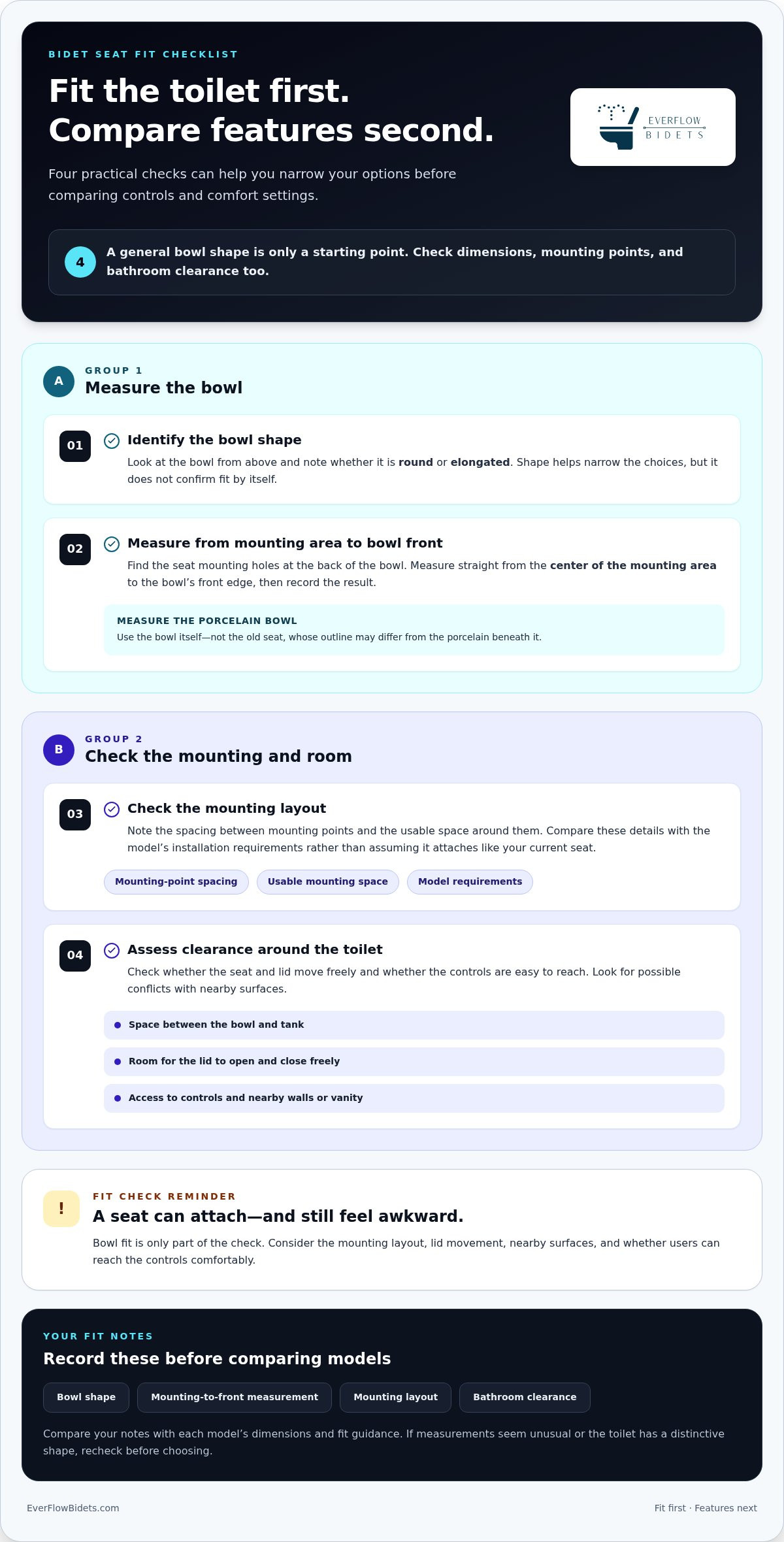
Check your toilet before weighing features. A seat can match the general shape of a bowl yet fail to line up with its mounting points or fit comfortably in the bathroom. Use this sequence to narrow your options before comparing controls and comfort settings.
- Identify the bowl shape. Look at the bowl from above and note whether it is round or elongated. Shape is a useful starting point, but it doesn’t confirm fit on its own. Toilets in the same broad shape category can still have different dimensions.
- Measure from the mounting area to the front. Locate the seat mounting holes at the back of the bowl. Measure straight from the center of the mounting area to the front edge of the bowl. Record the result and compare it with the fit guidance for each seat.
- Check the mounting layout. Note the spacing between mounting points and the usable space around them. Compare these details with the model’s installation requirements. Don’t assume that a replacement seat will attach the same way as your current one.
- Assess clearance around the toilet. Check the space between the bowl and tank, whether the lid can open and close freely, and whether there’s room to reach the controls. A seat may fit the bowl but feel awkward if its shape or controls conflict with nearby surfaces.
Measure the bowl and confirm its shape
Use a tape measure and write down the bowl shape and the distance from the mounting area to the front edge. Measure the porcelain bowl itself, not the old seat, because the seat’s outline may differ from the bowl beneath it. Compare your notes with the dimensions and fit guidance for each model. Don’t rely on “round” or “elongated” alone.
Check mounting space and bathroom clearance
Inspect the toilet with the lid raised and lowered. Look for anything that could limit seat movement or access to the controls, such as a close-fitting tank, wall, or vanity. Review the model’s mounting requirements as well. These checks help distinguish a seat that can attach from one that will work comfortably in your bathroom.
If your measurements seem unusual or the toilet has a distinctive shape, recheck the bowl and mounting points before ordering. Compare them with the model’s fit information, and resolve any mismatch before choosing. Careful measurements are more useful than choosing by appearance alone. Once you’ve recorded the essentials, you can compare bidet seat options with fit as your first filter.
Which Bidet Toilet Seat Features Are Worth Comparing?
Start with what the seat needs to do every day, then consider which conveniences would improve your routine. A long feature list can look impressive, but extra functions matter only if they’re useful and comfortable for the people sharing the bathroom. Check each model’s product details: functions and controls vary, and a feature on one seat isn’t necessarily available on another.
Use this comparison to separate cleansing essentials from optional comforts:
| Function | Likely benefit | Questions to consider |
|---|---|---|
| Water cleansing controls | Let users operate the rinse and, on some models, adjust settings. | Are the controls clear? Can users choose settings that suit their preferences? |
| Warm-water function | May make cleansing more comfortable than a room-temperature rinse. | Does this matter to your household, and what does the model’s product information specify? |
| Heated seat | Adds warmth while seated, a comfort feature some users may value. | Will it be used often enough to prioritize? |
| Air dryer | Provides an optional drying step after cleansing. | Does it suit your routine, or do you prefer another drying method? |
| Side-panel or remote controls | Offers different ways to access settings. | Which location and layout are easiest for the people using the bathroom? |
Cleansing controls and comfort functions
Prioritize controls that make the cleansing function straightforward to use. Adjustable settings can help household members tailor their experience, but the available adjustments differ by model. Review the product details to see which settings are included rather than assuming every seat offers the same choices.
Warm water and a heated seat are comfort options, not requirements for every buyer. An air dryer is another optional convenience. It may suit some routines, but it won’t replace every user’s preferred way of drying. Decide which functions are must-haves and which are extras before comparing models.
Controls, accessibility, and household preferences
A side panel keeps the controls attached to the seat; a remote places them separately. Neither approach is right for everyone. Consider reach, readability, the bathroom layout, and whether the controls will be easy to use from a seated position. Simple, clearly understood controls can be especially helpful when people with different preferences share a bathroom.
The TOTO S7A WASHLET bidet seat is one model to include in a comparison. Weigh its listed features against your priorities instead of treating it as a universal recommendation. If accessibility is a priority, focus on whether the controls and routine feel manageable for the user. Comfort is personal: a feature earns its place when it makes everyday use easier for your household.
What to Know About Bidet Seat Installation, Power, and Care
Setup is part of choosing a seat, not an afterthought. Before ordering, consider whether the model needs electricity, what its installation instructions involve, and how it should be cared for. These details can help you avoid choosing features that don’t suit your bathroom setup.
Plan for installation and electrical access
Non-electric seats don’t need an electrical connection for powered functions. Electric models do, so check the selected model’s instructions and your bathroom layout to see whether a suitable outlet is within reach. Requirements vary, so don’t assume every electric seat needs the same setup.
Review the installation instructions before choosing a model. Note the steps and connections the manufacturer specifies, and consider whether there’s enough space around the toilet to complete the setup. If the instructions call for an outlet that isn’t in a practical location, factor that into your decision before purchasing. Avoid relying on generic wiring advice: electrical requirements depend on the product and the home.
Follow the model’s instructions for installation, using only the connections and components it specifies. A bidet toilet seat may be designed to replace an existing seat, but products don’t all install the same way, and bathroom setups vary.
Keep the seat clean and ready for daily use
Care requirements vary by model. Follow the manufacturer’s directions for cleaning the seat, controls, and nozzle. Don’t assume a cleaner or method that works for one model is suitable for another. Check the product guidance before applying cleaning products, using tools, or moving or cleaning components.
Keep routine care simple: use the recommended cleaning method, follow any nozzle-care instructions, and avoid products or techniques the manufacturer advises against. For more detailed upkeep steps, consult the dedicated bidet seat cleaning guide as part of your ownership planning.
Before settling on a model, make a short setup checklist: confirm its power needs, review the installation instructions, and understand how to care for its surfaces and nozzle. This lets you compare the full ownership experience, not just the functions you’ll use. Once you know what your bathroom can accommodate, compare bidet toilet seat options with setup requirements in mind.
How to Choose a Bidet Toilet Seat That Fits Your Home
A good choice fits your toilet, supports your household’s routine, and works with your bathroom setup. Use this sequence to narrow your options without assuming that a longer feature list means a better fit.
- Confirm fit. Use your toilet’s shape and measurements to find models whose fit guidance matches your bowl and mounting layout. Set aside options that don’t meet those requirements.
- Prioritize daily functions. Decide which cleansing controls or comfort features you expect to use often. Separate must-haves from extras that may rarely matter in practice.
- Review setup. Check the selected model’s installation instructions, electrical needs if applicable, and care guidance. Make sure these requirements suit your bathroom and the way you plan to maintain the seat.
Match the seat to your household priorities
Consider who will use the seat and whether their preferences differ. One person may value uncomplicated controls, while another may prefer adjustable settings or a comfort feature. Accessibility matters, too: consider whether each user can comfortably reach and understand the controls as part of their usual routine.
Rank your priorities before browsing: fit first, then preferred controls, comfort, and accessibility needs. Mark each item as essential, useful, or optional. This makes trade-offs easier to see. If a feature doesn’t address a regular household preference, it may matter less than a reliable fit or an easy-to-use control layout.
Compare suitable options and take the next step
Once you’ve confirmed your toilet’s shape and measurements, review the details for models that appear compatible. Product information can help you compare functions and setup, but keep your own priority list beside you. A heated seat may be a deciding factor for one household and an unused extra for another. The strongest choice is the one that serves your routine, not the one with the most listed functions.
Before making a final selection, work through the decision in order: does the fit guidance match your toilet, do the controls and features support the people who will use the seat, and can your bathroom accommodate its setup and care requirements? If something is unclear, review the model’s product information rather than relying on a general feature label.
With your priorities established, explore EverFlow Bidets bidet toilet seat collection and compare options against your needs. Keep your measurements and checklist handy as you browse. This keeps the decision grounded in fit and everyday use while leaving room to choose the comfort and convenience that feel right for your home.
Make Your Bathroom Upgrade a Confident Choice
A bathroom can be more than a functional room. A thoughtful upgrade can make everyday personal care feel more considered and help your home reflect the way you want to live. A bidet toilet seat is one way to bring that intention to a space you use daily.
Take the next step by comparing product information and considering which functions suit your home. EverFlow Bidets offers a selection of bidet toilet seats, including options from TOTO and Bio Bidet.
Explore EverFlow’s bidet toilet seat selection and compare models for fit, controls, and comfort. Choose the option that best suits your bathroom and everyday routine.
Frequently Asked Questions
Can I use a bidet toilet seat without toilet paper?
Some people use a bidet seat and still keep toilet paper in their routine; others choose a different drying method. The wash function doesn’t mean you’ll stop using paper entirely. You might use the rinse and then pat dry with toilet paper or a clean towel, depending on your preference and the seat’s functions. Choose a routine that feels comfortable rather than expecting a specific reduction in paper use.
Do bidet toilet seats use a lot of water?
A bidet seat uses water for cleansing, but consumption depends on the model, selected settings, and frequency of use. There isn’t one figure that applies to every seat and household. If water use is a deciding factor, look for published consumption information for the specific model you’re considering. Household habits matter, too, so broad estimates may not reflect your actual use.
Can a bidet toilet seat be used by multiple people in one household?
Yes, a household can share one seat. Preferences may differ, so consider whether users can comfortably operate its controls and choose settings they like. A straightforward control layout may suit a household with users who have different levels of familiarity with bidets. Everyone should follow the model’s directions for use and cleaning to keep the routine clear and consistent.
What happens if the power goes out while I have an electric bidet seat?
During a power interruption, powered functions may stop working. The exact behavior depends on the model. Heating, powered controls, or drying may be unavailable until power returns. The toilet’s basic use is separate from those electric features, though flushing depends on the toilet and the home’s water supply. Check the seat’s manual for its specific behavior, since backup functions aren’t universal.
Can a bidet seat be installed on a one-piece toilet?
Some seats fit some one-piece toilets, but the toilet style alone can’t confirm compatibility. The bowl’s shape, mounting area, tank position, and clearance around the seat all affect fit. Measure the toilet and compare your measurements with the seat’s fit information before choosing a model. Pay particular attention to the space between the tank and mounting area, since designs vary even among toilets with a similar appearance.
Is a bidet seat difficult to keep clean?
Routine cleaning depends on the seat’s design and the manufacturer’s directions. Check the manual before choosing a cleaner or method, since products and components can have different care requirements. Avoid abrasive cleaners unless the manufacturer specifically permits them, and don’t assume a nozzle or other part can be removed. For step-by-step maintenance advice, refer to the dedicated bidet seat cleaning guide and follow the instructions for your model.
Can a bidet seat help someone with limited mobility?
A seat’s cleansing functions and controls may make parts of a bathroom routine more convenient for some people, but individual needs differ. Consider the user’s reach, comfort, ability to operate the controls, and bathroom layout before selecting a model. A bidet seat isn’t a treatment or a guarantee of improved mobility. For advice tailored to someone’s medical or accessibility needs, consult an appropriate healthcare or accessibility professional.
Disclaimer
The information provided in the EverFlowBidets blog is for general informational and educational purposes only. While we strive to publish accurate, current, and well-researched content, nothing on this website should be considered medical advice, diagnosis, or treatment. Articles discussing the potential health, hygiene, accessibility, or environmental benefits of bidet use are based on publicly available research, manufacturer information, and other reputable sources. Individual results may vary, and any health-related decisions should be made in consultation with a qualified healthcare professional.