

What if postpartum hygiene is less about choosing the “right” device and more about having control over your routine? A bidet for postpartum care may offer a hands-free way to rinse, while a peri bottle may be a more portable option. Recovery needs vary, so comfort and your healthcare professional’s guidance matter more than a one-size-fits-all recommendation.
It’s understandable to want a gentler, easier bathroom routine when soreness or limited movement makes wiping and reaching uncomfortable. This guide compares an installed bidet seat with a portable peri bottle and explains what to consider when choosing between them. A bidet is a hygiene aid, not a treatment or a substitute for individualized medical advice.
You’ll also learn how your bathroom setup and personal comfort can shape the choice, including whether an installed seat might be convenient for everyday use. Before trying a bidet or changing your postpartum care routine, ask your doctor, ob-gyn, or midwife what’s appropriate for your recovery.
Key Takeaways
- A bidet for postpartum care is a hygiene option, not a treatment. Follow a healthcare professional’s guidance for your individual recovery.
- Bidet designs and controls vary, so learn how a specific model works before deciding whether it suits your routine.
- Compare portable peri bottles and installed bidet seats by portability, setup, bathroom fit, and expected everyday use.
- Follow your clinician’s advice, use only settings that feel comfortable, and pause if rinsing causes discomfort.
- For a bathroom upgrade, consider whether a bidet seat fits your existing toilet or a bidet toilet better suits your plans.
Can a Bidet Be Used for Postpartum Care? Start With Comfort and Individual Needs
A bidet may be one option for personal hygiene after birth, but there’s no single routine that suits every recovery. Some people may prefer rinsing with water, while others may follow the care instructions and use the supplies recommended by their healthcare professional. Comfort, personal preference, and the specifics of your recovery all matter.
In this context, a bidet for postpartum care means considering a bathroom fixture for rinsing the external area after using the toilet. It’s a hygiene option, not a treatment. A bidet can’t assess your recovery or replace advice from your doctor, ob-gyn, or midwife.
General information can explain how a bidet works, but it can’t determine what’s appropriate for you. A bidet may support everyday hygiene, but individualized postpartum care advice should come from your healthcare professional. Follow your clinician’s instructions, especially if they address a specific concern or differ from general guidance.
What does postpartum bidet care mean?
A bidet directs water for external cleansing after using the toilet. Designs range from standalone fixtures to features integrated into a toilet or seat, and controls vary by model. For a basic overview of bidet types and their background, see What is a Bidet? The key distinction is that a rinse cleans externally. It isn’t internal washing and shouldn’t be treated as medical care.
Why can comfort and control matter after birth?
Bathroom routines may feel different during recovery, and people’s experiences aren’t all the same. A bidet’s controls are one practical consideration: knowing how to operate and stop the rinse can help you decide whether the fixture feels manageable. That’s a matter of personal fit, not a medical benefit or a promise about recovery.
Consider your own routine and comfort rather than assuming a bidet is automatically the better choice. If you’re unsure whether using one fits your recovery, ask your healthcare professional before trying it. They can advise based on your circumstances and any care instructions they’ve already provided.
Bring personal questions to your doctor, ob-gyn, or midwife, especially if you have symptoms that concern you or aren’t sure how to follow your care instructions. General hygiene information can describe an option, but it can’t evaluate symptoms or tailor advice to your recovery. Your clinician’s direction takes priority.
How a Bidet Rinse Works, and What It Can and Cannot Do
A bidet rinse is a stream of water used to clean the outside of the body after using the toilet. The basic idea is simple, but the experience depends on the fixture. Bidet seats and toilets can differ in nozzle design, controls, and water settings. Understanding those differences helps set realistic expectations. A bidet is a hygiene fixture, not a medical device, and it can’t replace a clinician’s advice.
A bidet rinse is an external water cleanse, not a treatment or a substitute for personalized postpartum care. A fixture can provide a way to rinse, but it can’t assess symptoms or determine what’s appropriate for an individual recovery. For broader information about postpartum recovery, MedlinePlus offers Understanding Postpartum Recovery. Follow your healthcare professional’s instructions for personal care.
What is the difference between external rinsing and internal washing?
External rinsing means directing water toward the body’s outside surfaces for routine cleansing. It doesn’t mean washing internally. Don’t use a bidet for internal cleansing or as treatment for a health concern. If you have questions about personal care, symptoms, or instructions after birth, your doctor, ob-gyn, or midwife can give guidance tailored to you.
Which controls can affect the experience?
Controls vary by model. Depending on the bidet, you may be able to adjust water direction, pressure, or temperature; another fixture may offer different functions. Don’t assume every bidet has the same options. Read the product instructions and learn what each control does before use.
It can help to understand the controls before you need them. Review the manual, identify how the rinse starts and stops, and learn how available adjustments work. If a setting feels uncomfortable, stop rather than trying to push through it. For postpartum use, ask your healthcare professional whether a bidet rinse fits your personal care instructions. General product information can’t answer that medical question.
Think of the fixture as one possible part of a bathroom routine, not a solution for every postpartum need. Its practical value depends on what it does, what its controls allow, and whether it fits your preferences. If you’re considering an installed option for ongoing bathroom use, compare bidet toilet seats by their stated specifications and controls. Features aren’t standard across all models.
Portable Peri Bottle vs. Installed Bidet: Which Fits Your Routine?
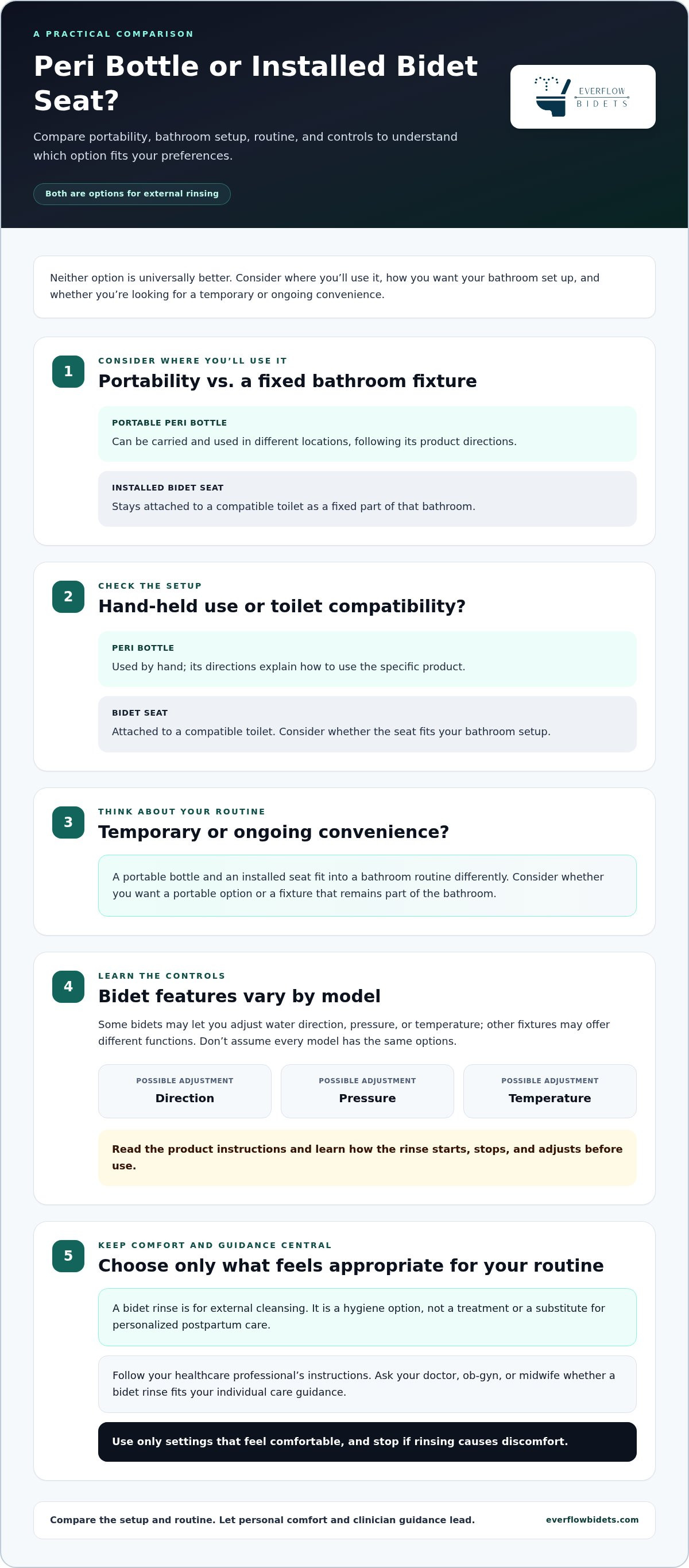
A peri bottle and an installed bidet seat can both provide water for external rinsing, but they fit into a bathroom routine differently. A peri bottle is portable and used by hand. An installed bidet seat stays attached to a compatible toilet, making it a fixed part of that bathroom. Neither option is universally better. Choose based on where you’ll use it, how you want to set up your bathroom, and whether you want a temporary or ongoing convenience.
| Consideration | Portable peri bottle | Installed bidet seat |
|---|---|---|
| Portability | Can be carried and used in different locations, following its product directions. | Attached to one compatible toilet; it isn’t a take-along option. |
| Setup | Used as a separate handheld item, without becoming part of the toilet. | Requires installation on a compatible toilet, so fit and setup matter. |
| Bathroom integration | Stored separately and brought out when needed. | Becomes part of the toilet in the bathroom where it’s installed. |
| Ongoing use | May suit someone who values a portable option for a particular period or different locations. | May suit a household looking for a fixture used as part of its regular bathroom routine. |
When might a portable peri bottle suit someone better?
Portability can be useful if you want an option that travels with you or can be used outside your home bathroom. A peri bottle remains a separate item, so you can bring it wherever your routine requires. Follow the bottle’s directions and your personal care instructions. Designs and use can differ from one bottle to another.
When might an installed bidet seat fit a household routine?
An installed bidet seat stays attached to a compatible toilet for regular use in that bathroom. It may make sense if you’re considering a lasting bathroom convenience beyond postpartum needs. The tradeoff is that toilet compatibility and installation are part of the decision. One example is the TOTO S5 bidet seat. Its features illustrate the installed-seat category, not a postpartum-specific medical design.
The TOTO S5 Electronic Bidet Toilet Seat, model SW3446, is an elongated seat with a remote control that stores settings for up to four users. It has an EWATER+® auto-cleaning wand, a heated SoftClose® seat with up to five temperature settings, a warm-air dryer with five temperature settings, an automatic air deodorizer, and a night-light. These are product features to compare for everyday use; they don’t establish whether a bidet is appropriate for your recovery.
To explore installed options, compare the stated specifications of bidet toilet seats with your toilet setup and household needs. For a bidet for postpartum care, weigh portability against the convenience of a fixture, and let your clinician’s personal instructions guide your hygiene routine during recovery.
A Gentle Postpartum Bidet Checklist: Controls, Setup, and When to Pause
A clear routine starts with personal guidance, not a preset bidet setting. If you’re considering a bidet for postpartum care, use this checklist to approach the fixture thoughtfully while keeping your healthcare professional’s instructions at the center.
- Follow your clinician’s guidance. Use the care instructions from your doctor, ob-gyn, or midwife as your starting point. If their advice differs from general information about bidets, follow their instructions.
- Learn the controls before using them. Read the model’s instructions and identify how its functions start, adjust, and stop. Controls differ, so don’t assume a setting works the same way across fixtures.
- Choose only what feels comfortable. Make adjustments according to your comfort and the product directions. There’s no universal pressure, temperature, or routine that applies to every person.
- Pause if you feel discomfort. Stop using the rinse if it feels uncomfortable. Contact your healthcare professional for advice about symptoms, discomfort, or questions about your recovery.
How can readers approach a new bidet’s controls?
Get familiar with the controls and manufacturer’s instructions before relying on the fixture as part of your routine. If the bidet has adjustable functions, treat them as user controls, not a prescribed medical technique. Comfort varies, and a particular setting isn’t automatically suitable for every recovery. Stop if the experience feels uncomfortable.
Keep the product manual accessible, especially if the control labels or sequence aren’t intuitive at first. If someone else in the household helps with setup, have them show you how to operate and stop the rinse. Knowing how to end the spray matters as much as knowing how to start it. Follow any product-specific safety directions.
When should general bidet guidance give way to medical advice?
Your clinician’s instructions take priority over general educational content. Ask a healthcare professional about symptoms, discomfort, or uncertainty about what’s appropriate for your recovery. A bidet is a bathroom fixture, not a way to diagnose or treat a concern. Don’t rely on changing its settings to address a symptom or replace care advice.
Keep fixture maintenance separate from personal care decisions. Cleaning a bidet seat according to its product instructions helps you care for the bathroom equipment; it doesn’t provide medical guidance about postpartum hygiene. For questions about recovery, speak with your healthcare professional rather than treating a cleaning routine or bidet setting as a substitute.
Thoughtful setup means knowing the controls, respecting your comfort, and pausing when something doesn’t feel right. If you’re also considering an installed seat for everyday use, explore bidet options for your bathroom and compare their stated features with your household needs.
Choosing a Bidet Seat for Postpartum and Everyday Use
A bathroom upgrade should fit the room and your longer-term routine, not be selected on the assumption that a particular model is medically suited to postpartum recovery. A bidet seat attaches to a compatible existing toilet, while a bidet toilet combines the toilet and bidet functions in one fixture. Start by considering your current bathroom, the scope of the change you want to make, and each product’s stated specifications.
Which bidet-seat details are useful to compare?
Start with fit: review the product’s compatibility information alongside your toilet’s configuration. Then compare the listed controls, seat features, and installation requirements. For example, the TOTO S5 bidet seat has a remote control and heated seat, along with the features described above. These are details to weigh for everyday use, not guarantees of easier recovery or medical benefits.
Specifications are more useful than broad labels such as “postpartum-friendly.” Check the current product information for details relevant to your setup, then consider which functions you expect to use regularly. A feature may sound appealing, but it’s only a good fit if it suits your bathroom and preferences. Product details vary, so compare the specific model rather than assuming every bidet seat offers the same controls or functions.
- Fit: Does the seat match your existing toilet?
- Features: Which controls and seat functions are explicitly listed?
- Installation: What does the product information say the setup involves?
- Everyday use: Do the listed features make sense for your household beyond postpartum recovery?
How can an installed bidet fit into longer-term bathroom plans?
A bidet seat is an optional everyday bathroom upgrade, not a postpartum necessity. Since it attaches to a compatible toilet, it may suit a plan to update an existing fixture without replacing the whole toilet. A bidet toilet is a different option to consider when your bathroom plans involve changing the toilet itself. Compare the scope of each setup with your project and the product specifications.
For a bidet for postpartum care, keep two questions separate: whether a fixture’s stated features suit your household, and whether using it fits your personal recovery instructions. Product specifications can help answer the first. Your healthcare professional is the right person to advise on the second. A seat or integrated toilet may remain useful as an everyday convenience, but no product feature establishes that it’s appropriate for every recovery.
If you’re considering an installed option, explore the bidet toilet seat collection and compare listed features and compatibility with your bathroom plans. Choose for fit and regular use, and keep postpartum care decisions guided by your clinician.
Choose a Bathroom Setup That Fits Your Next Chapter
Your postpartum routine is personal, and a bathroom upgrade should make sense for your life beyond recovery, too. Think about the setup you’ll use regularly, how it fits your existing toilet, and which listed features matter to your household. A bidet for postpartum care is an optional hygiene choice, not a medical necessity. Keep questions about your individual recovery with your healthcare professional.
EverFlow Bidets sells bidet seats, bidet toilets, and bidet-toilet combinations, including products from TOTO and Bio Bidet. Customer reviews also mention responsive assistance and installation guidance, which can help inform a bathroom-planning decision.
If an installed seat suits your everyday plans, explore bidet toilet seats for everyday bathroom comfort. Compare the options with your bathroom setup and preferences. Browse EverFlow Bidets’ bidet seats, bidet toilets, and bidet-toilet combinations to find an option that fits your home.
Frequently Asked Questions
Is it safe to use a bidet after giving birth?
A bidet may be an option after birth, but whether it’s appropriate for you depends on your recovery and your clinician’s instructions. Ask your doctor, ob-gyn, or midwife before trying one, particularly if you have specific care directions or concerns about symptoms. If your clinician says it’s suitable, follow the fixture’s manual and stop if it causes discomfort. A rinse is for hygiene, not treatment or a replacement for follow-up care.
Can I use a bidet instead of a peri bottle postpartum?
Possibly, if your healthcare professional agrees that it fits your care instructions. A peri bottle is portable and can be used in different locations, while a bidet is tied to a particular bathroom setup. You might prefer a bottle when you need something easy to carry, or an installed fixture for regular use at home. Neither is automatically the right choice for every person or recovery.
When can I start using a bidet after delivery?
There isn’t a universal start date that applies to everyone after delivery. Ask your doctor, ob-gyn, or midwife when, or whether, a bidet fits your individual care plan. This is especially useful if you were given specific instructions for bathroom hygiene or follow-up. Don’t use a general timeline from an article to override advice from the professional familiar with your delivery and recovery.
Can a bidet rinse affect stitches after birth?
Whether rinsing is appropriate around stitches depends on your clinician’s directions and your individual recovery. Don’t assume a bidet setting is suitable for your situation. Ask your doctor, ob-gyn, or midwife how to care for the area and whether a rinse is appropriate. If using a bidet feels painful or you notice a symptom that concerns you, stop and seek medical advice rather than trying to adjust the fixture to solve it.
Should I use warm or cold water for postpartum bidet care?
There’s no single water temperature recommendation for every postpartum situation. Follow your clinician’s guidance and the bidet’s instructions, and don’t assume a model has temperature controls. Before choosing a fixture, read its current specifications to see which adjustments it actually provides. If you’re unsure what temperature is suitable for your care, ask your healthcare professional instead of relying on a general preference or someone else’s routine.
Can I use an electric bidet seat after a C-section?
An electric bidet seat may be an option, but your clinician should advise whether it suits your recovery. Consider practical access as well: can you sit down, reach the controls, and stop the rinse without straining or discomfort? A seat’s controls and installation vary by model, so review its instructions. If movement or using the fixture causes pain, pause and ask your healthcare professional what to do.
Do I need a special bidet for postpartum care?
You don’t necessarily need a bidet marketed specifically for postpartum use. If considering a seat or integrated toilet, focus on its stated features, compatibility with your bathroom, and controls you expect to use. Product descriptions can help you compare fixtures, but they can’t determine medical suitability. A standard bathroom upgrade is optional, and your healthcare professional can advise whether using a bidet fits your personal care instructions.
Disclaimer
The information provided in the EverFlowBidets blog is for general informational and educational purposes only. While we strive to publish accurate, current, and well-researched content, nothing on this website should be considered medical advice, diagnosis, or treatment. Articles discussing the potential health, hygiene, accessibility, or environmental benefits of bidet use are based on publicly available research, manufacturer information, and other reputable sources. Individual results may vary, and any health-related decisions should be made in consultation with a qualified healthcare professional.